The group Everything After functioned as a performing ensemble from November 2004 to May 2009. During that time the group went thru several name changes and several different lineups. The last year of activity was perhaps the most fruitful. The group is documented on the Hubbard released Encinitas and Everything After (C&PM018).
The beginning of Everything After was Spring 2002, when Justin Grinnell asked me to compose a piece for his Junior Recital. After thinking about the setting, i wrote There is Beauty There Waiting For You for a quartet of vibraphone, piano/voice, acoustic bass and drumkit. The performers were Nathan Hubbard, Melonie Sacalamitao, Justin Grinnell and Dave Pshaida.
This idea of vibes, voice and piano sat around for awhile until early 2004, when i found an old notebook holding most of the music i wrote in high school and earlier. I put together a recording session to document most of it, using the (then working) group Something Strange Is Afoot (Nathan Hubbard, Justin Grinnell, James Burton) with Melonie Sacalamitao on Piano. We spent an afternoon dealing with my horrible handwriting and less than inspired harmonic language of that period. But this music put us into a more traditional space in terms of harmony and melody, which was a refreshing contrast to the multi-layered music we had been working on as a trio.
From that point, i began to work on a performing group, using some of this earlier music and writing new pieces based on this instrumentation and performers.
This new music has a clear beginning in the music i was writing for the quartet Return To One, especially during our Firecliffs era (2000-2001). However, where the RTO music was a melding of woodwind based music with voice, this music starts with the vibraphone and builds from there adding voice and piano.
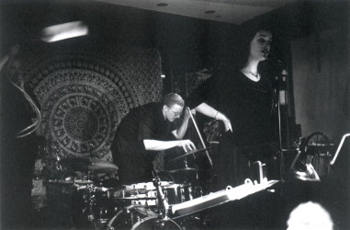 |
Return To One with Anne Whattoff 2001 |
This is vibraphone music - or perhaps a setting that allows the vibraphone to sound best. For me that is slower moving textures and harmonies - and contrasting that with motion from other instruments. The vibraphone has a unique attack and a nice sustain and i have tried to expand upon that in whatever setting i put the instrument.
One key ingredient of this group is the melding of the vibraphone and piano timbres, so much of this music is those instruments playing in unison. The addition of the female voice to the group adds a warmth and (much needed) definition of breath lengths.
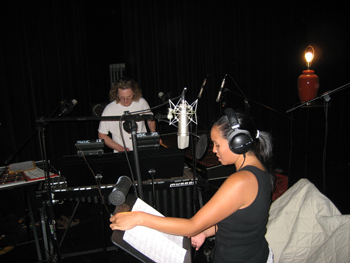 |
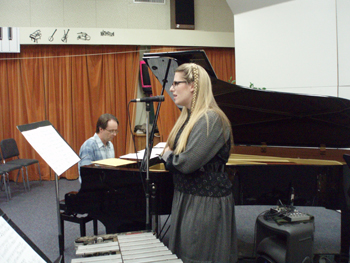 |
| Nathan Hubbard/Melonie Grinnell 2007 |
Nina Deering/Rick Helzer 2009 |
Originally the piano/vocal portion of this group was covered by Melonie Grinnell. After she stopped playing due to wrist injuries, pianist Bob Weller performed several gigs. For this period the vocal portion was put on a backburner. By 2007 Rick Helzer was covering the piano chair.
With the addition of Nina Deering to the group (2008), we found the strength and malleability to perform as a quartet (no piano) or as a quintet. Where the quintet focussed on extended pieces, the quartet combined shorter pieces and open improvisation and dealt more fluently with guests. |